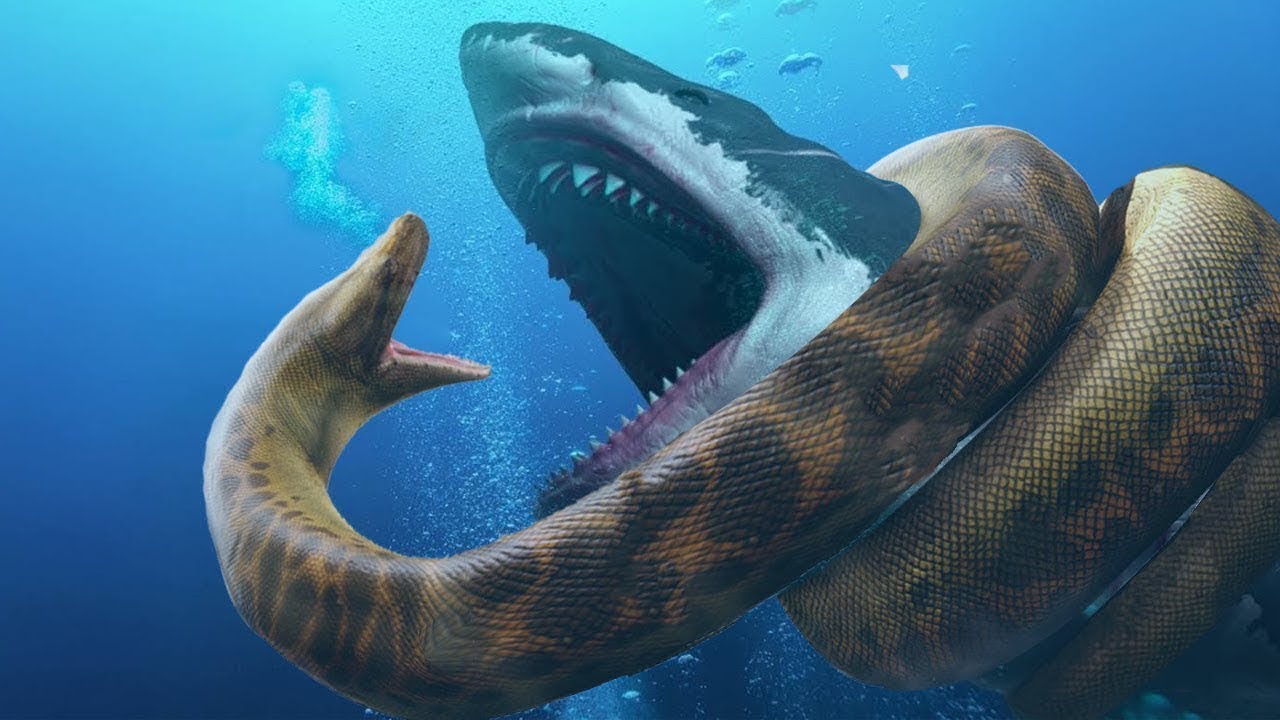
In the annals of prehistoric
history, two terrifying predators stand out for their sheer size and dominance:
the Megalodon, an enormous prehistoric shark, and the Titanoboa, a colossal snake
that once ruled the swamps. Though these two creatures lived millions of years
apart and in different ecosystems, imagining a battle between them is a
thrilling mental exercise—one that pits oceanic power against serpentine
stealth.
The Titans Awaken
The setting is a vast, ancient
coastal lagoon where fresh and saltwater mix—a rare habitat that allows both
creatures to encounter one another. The sun casts a fiery glow over the
mangroves and murky waters. Deep beneath the surface, the Megalodon, a 60-foot-long
monster weighing over 50 tons, glides with predatory grace. Its jaws, filled
with teeth the size of human hands, can exert over 40,000 pounds
of bite force.
Meanwhile, Titanoboa is slithering through the shallow, swampy edges, stretching over 45 feet long and weighing nearly 2,500 pounds. Its thick, muscular body moves with deceptive agility as it patrols the shoreline. Titanoboa’s strength lies in its ability to constrict and suffocate prey with bone-crushing force, estimated to be over 400 pounds per square inch.
The water begins to churn.
Clash of the Giants
The Megalodon senses movement in
the brackish water. Driven by instinct, it charges toward the disturbance.
Titanoboa, sensing the shift in pressure, coils back into a defensive posture
beneath the surface.
Without warning, the Megalodon
bursts forward in a titanic rush. The snake narrowly avoids the first bite,
twisting its body in a defensive roll. The massive shark’s teeth slash through
the water, missing flesh but stirring sediment into a swirling cloud.
Titanoboa retaliates by wrapping
its powerful body around the shark’s dorsal fin. The constriction begins. The
snake's muscular coils tighten, trying to restrict the Megalodon’s movement.
But in open water, the Megalodon has the advantage. It thrashes violently,
lifting the massive snake out of the water and slamming it against the surface
like a whip. Each movement sends shockwaves through the lagoon.
The snake holds on, its instinct
to suffocate overriding the chaos. The Megalodon, however, is not prey—it’s a
predator. With a violent twist of its head, it manages to sink its razor-sharp
teeth into Titanoboa’s thick midsection. Blood clouds the water as the shark's
jaws clamp down.
The Tide Turns
For a moment, it seems the
Megalodon has won. But Titanoboa is not dead yet. Despite the deep bite wound,
it tightens its coils with desperate intensity. The Megalodon begins to tire,
its gills needing more water flow than the constriction allows. The snake’s
grip tightens like a vice.
Yet, in a final act of raw power,
the Megalodon thrusts itself into deeper water, dragging Titanoboa along. The
snake begins to lose leverage. With one last mighty shake, the Megalodon tears
free, ripping through the snake’s flesh. Titanoboa unravels, bleeding heavily,
weakened.
The Aftermath
In the end, the Megalodon swims
away, wounded but alive. Titanoboa floats near the shore, barely breathing. In
a real-world scenario, both creatures are apex predators in their own right—but
in this imagined encounter, the battle favors the Megalodon, thanks to its
sheer power, stamina, and the advantage of open water.
The ancient lagoon falls silent
again, the red of sunset mingling with blood in the water. One titan returns to
the deep; the other fades into legend.
Post a Comment